contact@cayeit.com

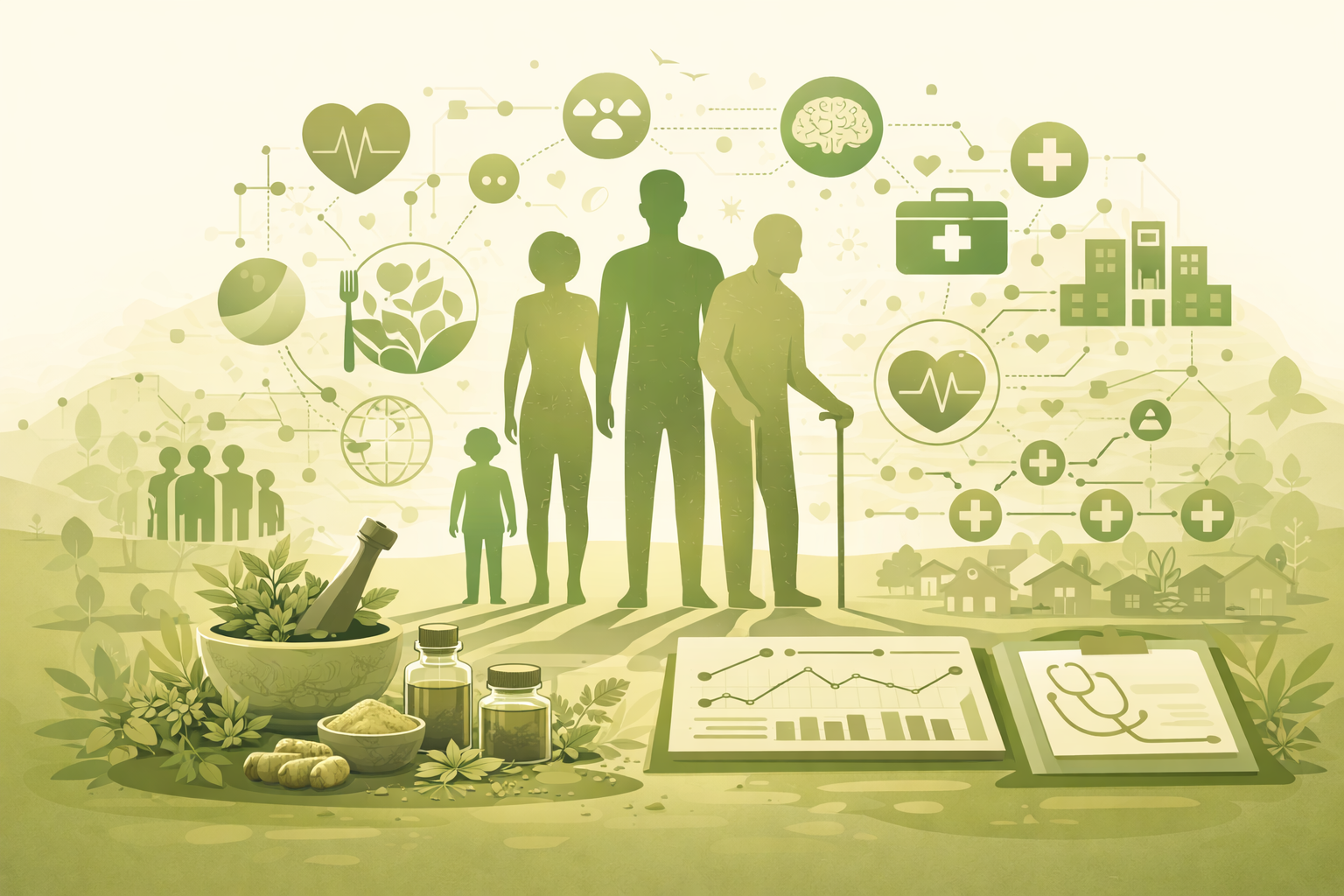
From Individual Therapy to Population Health
The year 2025 marked a structural repositioning of Ayurveda within public health discourse, both in India and globally. Ayurveda was no longer discussed only as a system of individualized clinical care or wellness practice. Instead, it increasingly emerged as a preventive, promotive, and population-relevant health framework, aligned with national health priorities and international strategies addressing non-communicable diseases, mental health, aging populations, and health system sustainability.
This transition from individual therapy to population health was underpinned by policy recognition, public health research, national programs, and global institutional frameworks.
1. Prevention at the Core of Ayurveda’s Public Health Relevance
Ayurveda’s foundational orientation is preventive. Concepts such as dinacharya (daily routine), ritucharya (seasonal adaptation), ahara (diet), vihara (lifestyle), agni (metabolic regulation), and early correction of imbalance are inherently designed for large-scale application.
In 2025, this preventive philosophy aligned closely with global public health priorities, as health systems struggled to manage escalating burdens of lifestyle-related disorders.
The World Health Organization, in its Global Traditional Medicine Strategy 2025–2034, explicitly positions traditional medicine systems as contributors to:
- Health promotion
- Disease prevention
- Primary healthcare and universal health coverage
WHO. Global Traditional Medicine Strategy 2025–2034
https://www.who.int/publications/i/item/WHO-TRM-2025-2034
WHO. Traditional, Complementary and Integrative Medicine overview
https://www.who.int/health-topics/traditional-complementary-and-integrative-medicine
2. Addressing the Global and National NCD Crisis
In 2025, Ayurveda’s preventive relevance was increasingly discussed in the context of non-communicable diseases (NCDs), which account for over 70% of global mortality.
Globally, WHO frameworks emphasize that NCD prevention depends heavily on lifestyle, behavior change, and community-based interventions, areas where Ayurveda offers structured guidance.
In India, Ayurveda’s alignment with NCD prevention was reinforced through national strategies focusing on diabetes, obesity, cardiovascular diseases, and mental health.
WHO. Noncommunicable Diseases
https://www.who.int/health-topics/noncommunicable-diseases
Frontiers in Public Health. Traditional medicine and NCD prevention
https://www.frontiersin.org/journals/public-health
Ministry of Health & Family Welfare. National Programme for Prevention and Control of Cancer, Diabetes, Cardiovascular Diseases and Stroke (NPCDCS)
https://nhm.gov.in/index1.php?lang=1&level=2&sublinkid=1048&lid=604
Ministry of AYUSH. Role of AYUSH systems in lifestyle disease prevention
https://www.ayush.gov.in/
3. Community-Based Preventive and Wellness Models
A defining development in 2025 was the growing emphasis on community-level implementation of Ayurveda-based preventive models.
Rather than remaining clinic-centric, Ayurveda principles were increasingly explored through:
- Group lifestyle counseling programs
- Community wellness initiatives
- Seasonal health advisories
- Integration with yoga, nutrition, and behavioral science
These approaches aligned strongly with the WHO’s Primary Health Care (PHC) model, which prioritizes prevention, community engagement, and culturally appropriate interventions.
WHO. Primary Health Care
https://www.who.int/health-topics/primary-health-care
UNICEF & WHO. Community health and preventive strategies
https://www.unicef.org/health
Ministry of AYUSH. AYUSH Health & Wellness Centres
https://www.ayush.gov.in/docs/ayush-hwc.pdf
National Health Mission. Health and Wellness Centres
https://nhm.gov.in/
4. Mental Health, Stress, and Psychosocial Wellbeing
Beyond physical NCDs, Ayurveda’s contribution to mental health promotion and stress management gained greater attention in 2025.
Ayurveda’s emphasis on:
- Sleep regulation
- Diet–mind interaction
- Routine and rhythm
- Mind–body balance
aligned with global recognition that mental health promotion cannot rely solely on pharmacological models.
WHO. Mental Health Promotion and Prevention
https://www.who.int/teams/mental-health-and-substance-use
The Lancet Commission on Global Mental Health
https://www.thelancet.com/commissions/global-mental-health
Ministry of Health & Family Welfare. National Mental Health Programme
https://www.nhp.gov.in/national-mental-health-programme_pg
Journal of Ayurveda and Integrative Medicine. Ayurveda and mental wellbeing
https://www.jaim.in/
5. Integration with Primary Healthcare Systems
In 2025, both national and international policy discussions increasingly focused on integrating Ayurveda into primary healthcare and preventive services, rather than treating it as a parallel or alternative stream.
Key themes included:
- Standardized preventive protocols
- Training of community and primary care workers
- Referral linkages between Ayurveda and biomedical services
- Outcome monitoring and safety assurance
WHO. Integrating traditional medicine into health systems
https://www.who.int/health-topics/traditional-complementary-and-integrative-medicine
WHO. Universal Health Coverage
https://www.who.int/health-topics/universal-health-coverage
Ayushman Bharat Programme
https://abdm.gov.in/
National Health Policy 2017
https://www.nhp.gov.in/nhpfiles/national_health_policy_2017.pdf
6. Evidence-Informed Public Health Research
A key shift in 2025 was the insistence that Ayurveda’s public health role be evidence-informed and outcomes-oriented.
Research increasingly focused on:
- Effectiveness of lifestyle interventions at scale
- Community adherence and feasibility
- Cost-effectiveness in preventive care
- Longitudinal population outcomes
This approach aligned Ayurveda with global expectations that public health interventions demonstrate measurable and replicable benefits.
Indian Council of Medical Research (ICMR). Integrative health research
https://www.icmr.gov.in/
Frontiers in Public Health. Population health and traditional medicine
https://www.frontiersin.org/journals/public-health
CCRAS. Public health and lifestyle research initiatives
https://ccras.nic.in/
7. Equity, Accessibility, and Cultural Acceptability
Ayurveda’s increasing relevance in public health discourse in 2025 was also driven by its accessibility and cultural embeddedness.
For many communities, Ayurveda-based guidance is:
- Linguistically and culturally familiar
- Cost-effective and resource-light
- Focused on self-care and community resilience
These attributes align with global goals of health equity and universal access, particularly in low- and middle-income countries.
WHO. Health Equity
https://www.who.int/health-topics/health-equity
UN Sustainable Development Goal 3: Good Health and Well-being
https://sdgs.un.org/goals/goal3
What 2025 Established
By the end of 2025, Ayurveda’s public health role had clearly evolved:
- From individual therapy → population-level prevention
- From clinic-centered care → community-based models
- From anecdotal positioning → evidence-informed programs
- From parallel practice → complementary public health integration