contact@cayeit.com

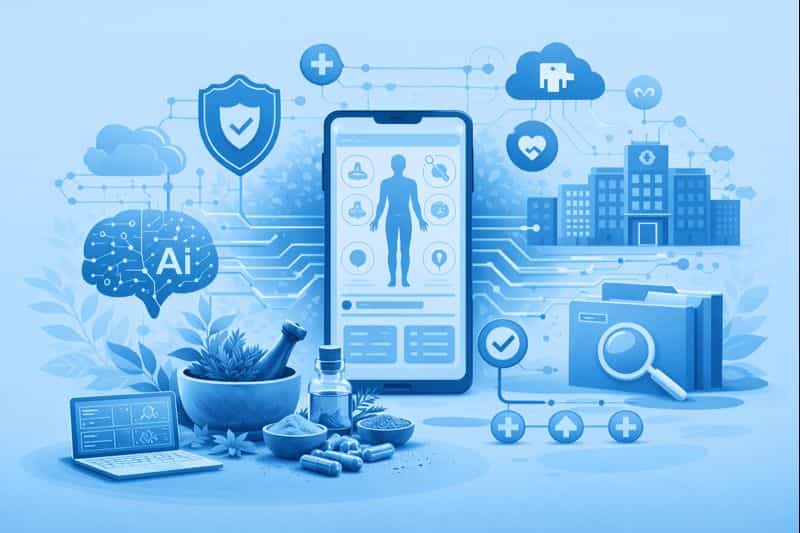
From Experiments to Health-System Infrastructure
In 2025, the narrative around Digital Ayurveda and Artificial Intelligence (AI) matured significantly. What had previously been dominated by isolated wellness apps, curiosity projects, and pilot tools transitioned toward system-level alignment, governance frameworks, and infrastructure readiness. This shift reflected the global health community’s expectations that digital innovations in traditional medicine must be safe, interoperable, evidence-based, and embedded within health systems, not detached consumer experiments.
This article synthesizes the key developments, global frameworks, innovations, and implications of Digital Ayurveda and AI in 2025, supported by authoritative references.
1. The Strategic Context: WHO & Digital Health Integration
A foundational driver in 2025 was the World Health Organization’s broader digital health agenda, which established clear expectations for digital integration, data governance, interoperability, and ethical use of AI in health-related domains.
- WHO’s Global Strategy on Digital Health 2020–2025 and subsequent policy conversations emphasized interoperable systems, data standards, outcome tracking, and governance of AI tools in clinical and public health use.
Reference: WHO Global Strategy on Digital Health 2020–2025
https://iris.who.int/handle/10665/344249 - At the 2nd WHO Global Summit on Traditional Medicine (New Delhi, Dec 2025), WHO reiterated that digital tools in traditional medicine must support clinical accountability, safety reporting, and evidence generation, and must not amplify misinformation or unvalidated claims.
Reference: WHO Summit outcome on digital integration
https://www.who.int/news/item/22-12-2025-who-global-summit-charts-a-bold-future-for-traditional-medicine
Implication: Digital Ayurveda was no longer considered an industry peripheral. It was being positioned as a core component of health data ecosystems aligned with WHO digital health priorities.
2. ICD-11 and Digital Health Readiness
A critical enabling development in 2025 was the updated ICD-11 release, which reinforced support for interoperable clinical coding, including optional dual coding for traditional medicine morbidity data. ICD-11 is engineered for digital health environments via FHIR (Fast Healthcare Interoperability Resources) and advanced Natural Language Processing (NLP) capabilities for clinical documentation.
- The update enhances the ability of Ayurveda clinicians to electronically record, share, and analyze clinical data in standardized health information systems.
https://www.who.int/news/item/14-02-2025-who-releases-2025-update-to-the-international-classification-of-diseases-%28icd-11%29
Implication: Digital Ayurveda is system-ready; clinical records, diagnostic codes, and outcome data can now flow through conventional health data architectures.
3. The Traditional Medicine Global Library (TMGL)
One of the most consequential digital developments of 2025 was the launch of the WHO Traditional Medicine Global Library (TMGL) -a structured, searchable, multi-epistemic repository of evidence, policy documents, research summaries, and clinical knowledge related to traditional medicine systems, including Ayurveda.
- TMGL aims to democratize access to credible resources and reduce reliance on fragmented, unvalidated sources.
https://tmgl.org/
Implication: The TMGL provides the knowledge backbone for evidence-informed Digital Ayurveda platforms, research tools, and policy analytics.
4. AI and Clinical Decision Support: Guardrails and Governance
The buzz around AI in traditional medicine shifted in 2025 from novelty to necessary governance and clinical accountability:
- WHO and national regulators emphasized that AI in health cannot operate in informational silos. It must be subject to clinical oversight, safety monitoring, and ethical use policies.
https://www.who.int/teams/digital-health-and-innovation - AI tools designed for Ayurveda now tend to focus on clinical decision support rather than autonomous diagnosis – supporting clinicians with text interpretation, dosage guidance, and evidence linkage rather than replacing clinical reasoning. https://www.who.int/publications/i/item/9789240107663 ; https://www.who.int/initiatives/global-initiative-on-ai-for-health
Implication: The role of AI in Ayurveda is maturing toward assistive intelligence, rooted in governance frameworks and clinician accountability.
5. Digital Integration with National Health Ecosystems
Progressive alignment between Digital Ayurveda tools and national health data infrastructures was visible in 2025, especially in countries with mature digital health policies:
- In India, advanced digital health initiatives like the Ayushman Bharat Digital Mission (ABDM) and telemedicine platforms such as eSanjeevani provided practical infrastructure for integrating Ayurveda into mainstream health data flows.
https://esanjeevani.mohfw.gov.in/ - Published discussions on digital integration of AYUSH with national systems highlighted opportunities and design considerations for interoperability and governance.
https://journals.lww.com/ijar/fulltext/2025/10000/harnessing_digital_health_for_integrating_ayush.15.aspx
Implication: Digital Ayurveda tools could leverage existing national infrastructure, not operate in isolation.
6. The End of the ‘Wellness App’ Phase
Until recently, most digital Ayurveda initiatives operated outside formal health systems. They focused on:
- Lifestyle advice and symptom checkers
- Consumer wellness tracking
- Content delivery and consultations without standardized records
In 2025, this model reached its limits. Global regulators, investors, and health agencies increasingly recognized that non-integrated digital tools cannot support safety monitoring, research evidence, or policy adoption.
This shift aligned with the World Health Organization’s digital health position, which emphasizes that digital health tools must be interoperable, accountable, and embedded within national health information systems.
https://www.who.int/teams/digital-health-and-innovation
6. Digital Supply Chain and Quality Traceability
Digital innovation in 2025 went beyond clinical and consumer interfaces to infrastructure that supports quality assurance and traceability:
- Blockchain, spectral fingerprinting, and digital traceability solutions were increasingly tested in Ayurvedic raw material value chains.
- These digital tools support authentication, pharmacopeial compliance, and supply chain traceability, which are prerequisites for regulatory acceptance in global markets.
Implication: Digital systems are now part of quality governance frameworks that strengthen industry credibility.
7. Research Data Ecosystems and Analytics
Another critical frontier in Digital Ayurveda has been the development of research data ecosystems:
- Shared digital registries and research databases enable aggregation of case outcomes, safety signals, and population health trends.
- Use of analytics and visual dashboards facilitates real-time insights and evidence synthesis, moving Ayurveda research toward big data and outcomes science.
Implication: Digital tools are enabling Ayurveda research to be data-rich, accessible, and analytically robust.
8. Responsible Innovation: Ethical Frameworks
Across 2025, policymakers and digital health leaders consistently stressed that innovation must be responsible and ethical:
- AI tools must avoid biases, ensure transparency, and safeguard patient privacy.
- Digital Ayurveda solutions must adhere to data protection norms and clinical governance principles.
- Unvalidated health claims or non-verified wellness advice on digital platforms were flagged as risks to public trust.
These ethical guardrails align with WHO’s broader digital health governance direction.
https://www.who.int/teams/digital-health-and-innovation/strategy
Implication: Digital Ayurveda innovation is no longer a “wild west”; it is anchored in ethical and accountable frameworks.
What 2025 Achieved for Ayurveda
In 2025, Digital Ayurveda was reshaped from a collection of isolated wellness tools to an integrated, accountable, and system-aligned discipline. The year’s progress was defined by several foundational shifts:
- Integration, not isolation, with health data systems
- Governance, not hype, for AI and digital tools
- Interoperability, not proprietary silos
- Evidence access, not opaque information
- Ethics and safety, not marketing narratives
These changes collectively position Digital Ayurveda not as an afterthought, but as a strategic enabler of evidence, quality, and policy-ready health insights.


